Giving the Cash-Up Calculator the Rest of the Table
The original poker calculator only ever handled one player at a time. It had no idea what to do with rebuys, a whole table cashing out at once, or a chip count that doesn't quite add up.
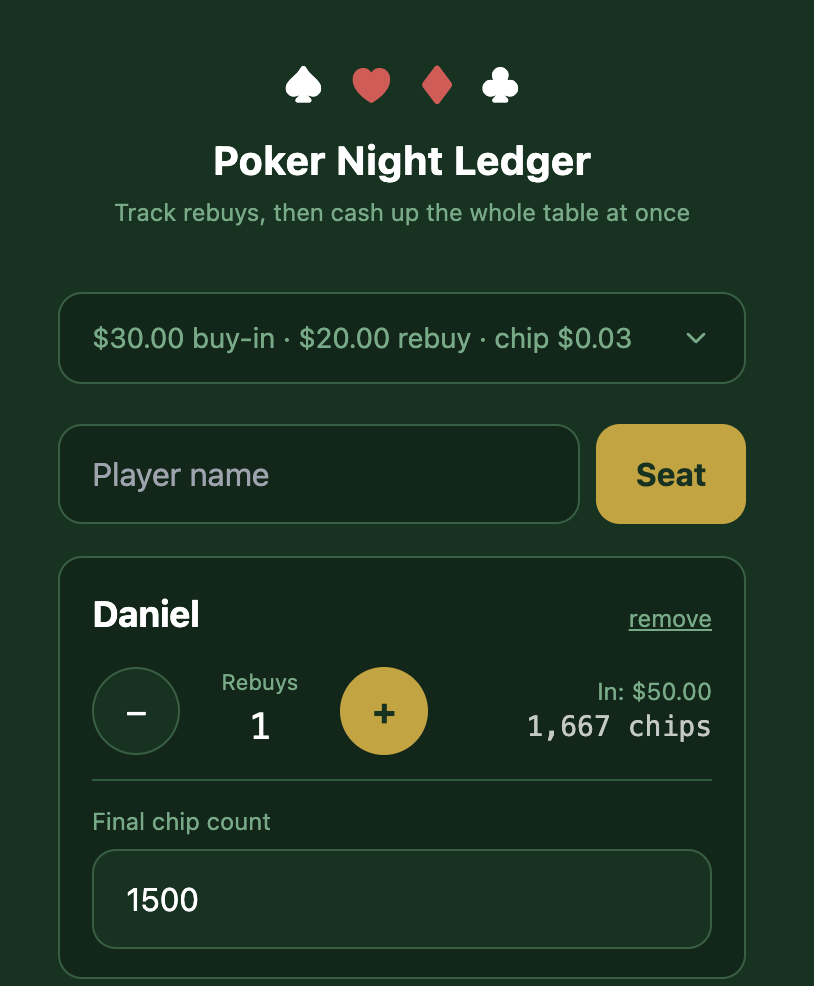
The first version did one thing well: type in a chip count, get a dollar figure back. It was fine for the banker doing the maths in their head at the end of the night. It was less fine for the actual mess of a real game, where three people rebuy at different points, someone's stack gets miscounted, and everyone is owed or owes a slightly different amount from everyone else.
What the Old Tool Couldn't Do
No rebuys. No roster. No way to settle an entire table in one pass. And nothing to do about the fact that chip counts, counted by hand by people who have been playing poker for four hours, almost never add up to the number of chips that actually went into play. The old calculator just assumed the count was correct and moved on.
What I Built
Poker Night Ledger seats a table, tracks rebuys per player with a tap-friendly plus and minus, and cashes everyone up together instead of one at a time. Each player settles once: the pot pays them, or they pay the pot. No working out who owes who.
The part I actually cared about is the chip count. If the table's count comes in short or over, which it always does, the tool doesn't block the cash-up or throw an error. It scales every player's payout proportionally so the total paid out always equals the total bought in, and shows a plain note explaining that the payouts were adjusted and by how much. The pot balances exactly, every time, whether or not the chip count does.
You can use it here. The original single-player calculator is still there too, for the nights when you just want a quick number.
Built Sideways, Not On Top
I prototyped the rebuy logic and the settlement maths in a Claude chat first, as a framework-agnostic module with its own self-test, separate from any UI. Then I handed that, plus a rough reference interface, to Claude Code with one instruction: keep the existing calculator exactly as it is, and build the new one as its own screen next to it, matching the site's own look rather than the prototype's. That is the whole workflow now: sketch the logic somewhere cheap to iterate, then let the agent merge it into the real codebase properly, styled to match, tested against the same numbers the prototype checked itself against.